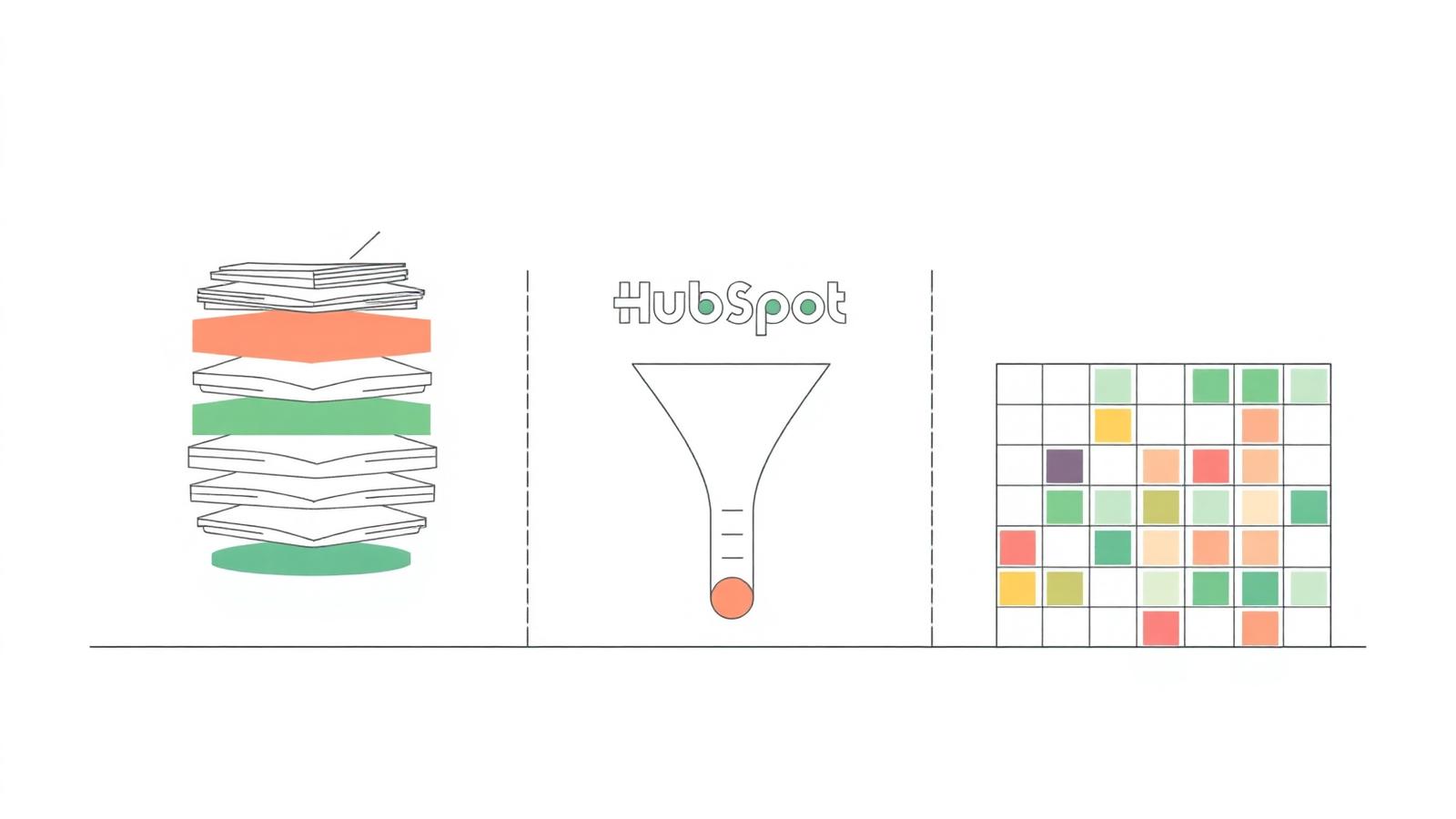
Every founder we talk to has the same shortlist. HubSpot for the CRM. Airtable for the ops databases. Notion for the wiki. Three subscriptions, three schemas, three places where the truth lives. In a 30-person company that already costs more than one senior hire, and the data never reconciles.
The question is not which tool is best in isolation. It is which tool can collapse the other two without making the team slower. Below is how we think about the trade in 2026, based on having migrated workspaces in both directions.
HubSpot: pipeline product, schema you do not own
HubSpot is the best inbound sales pipeline product on the market. The reporting works out of the box, the email integration is mature, and the marketing automation is genuinely good. If your business is fundamentally an inbound funnel with predictable deal stages, HubSpot earns its price.
The cost shows up at three moments. First, when you try to model anything that is not a contact, a company or a deal. Custom objects exist but feel grafted on. Second, when the Enterprise tier kicks in around 50 to 100 seats and the bill jumps from manageable to unignorable. Third, when you want to put an AI agent on top. The HubSpot data layer is reachable through their API, but the schema is theirs, the events are theirs, and the AI features are bundled at Enterprise pricing.
Airtable: powerful database, weak documents and agents
Airtable is the spreadsheet that grew up. Linked records, views, automations and an interface designer that beats most low-code tools. For operational databases like inventory, content calendars or vendor management, Airtable is hard to beat.
Where it falls short is the document layer. You cannot write a strategy memo in Airtable. You cannot run a meeting from it. The AI features are real but the agent surface is narrow. And the pricing scales aggressively with seats once you cross into Business or Enterprise. Teams end up with Airtable for the database and Notion or Google Docs for everything else, then spend energy keeping the two in sync.
Notion: the workspace that became a database
Notion started as a document tool. In 2023 it became a real database. In 2025 it became an agent platform with Custom Agents and an open MCP layer. For a 10 to 250 person company in 2026, that combination is the most leverage per euro available.
The single most important thing Notion does that the other two do not: documents and databases live in the same surface, owned by you, with agents that can read and write both. A deal record can sit inside the same workspace as the strategy memo that defines the deal stages, the playbook that the AE follows, and the agent that drafts the follow-up. Nothing is syncing, because nothing is separated.
Where each tool wins
- 01HubSpot wins for high-volume inbound sales teams above 100 reps where the cost of switching outweighs the cost of staying.
- 02Airtable wins for operational databases that need a polished non-technical interface for a specific workflow, like a content production line or a logistics tracker.
- 03Notion wins for the rest. Companies under 250 people that want one system of record, one place to write, and an agent layer that does not need a middleware vendor.
What founders get wrong
The most common mistake is to evaluate the three tools on feature parity. HubSpot has more sales features. Airtable has more database features. Notion has more document features. None of that matters at the founder level. The question is which tool will let you ship the next AI agent in two weeks instead of two quarters.
The answer in 2026 is almost always Notion. Not because the features are better, but because the schema is yours, the agent layer is native, and the cost stays linear as you grow.
The migration question
Migrating off HubSpot or Airtable into Notion is not a weekend project. It is two to four weeks of schema work, data migration, integration rewires and team retraining. We have done it more than 20 times. The pattern is the same: pick the two workflows that hurt most, migrate those into Notion first, leave the rest on the legacy tool for a quarter, then collapse the rest once the team trusts the new workspace.
If you want the full implementation playbook, the Notion AI operating system page lays it out. If you want a second opinion on whether your current stack is the bottleneck, book the audit.